
Change is possible, but therapy cannot promise it. If you’re wondering whether a narcissist can change with therapy, the clearest sign is a willingness to examine behaviour honestly, take responsibility for its impact, and keep practising different ways of relating.
You may have experienced warmth or regret, only to see old patterns return. That can leave you questioning your judgement and wondering whether to keep hoping. Both things can be true: change can happen, and you don’t have to put your wellbeing on hold while waiting for it.
This article explores how self-awareness and motivation can shape change, what sustained behavioural growth may look like, and why therapy is a process rather than a quick fix. It also considers how to stay connected to your own needs while making sense of a confusing relationship.
Key Takeaways
- Separate narcissistic traits from a personality disorder before drawing conclusions about someone’s behaviour.
- Notice whether they show genuine willingness to reflect, accept feedback and take responsibility.
- Look for consistent changes in actions and respect for boundaries, not apologies alone.
- Understand how therapy may support self-awareness and healthier ways of relating, while lasting change takes ongoing effort.
- Keep your own needs in view as you consider what support could help you feel clearer and steadier.
Can people with narcissistic traits change?
Change is possible when someone is willing to examine their behaviour and work on it consistently. Keep your wellbeing in view, too: you don’t have to wait for another person to change before deciding what you need.
Narcissistic Traits and Personality Disorder
I’d distinguish narcissistic traits, which can show up in particular behaviours, from narcissistic personality disorder, a persistent pattern assessed against diagnostic criteria. This matters if you’re trying to make sense of someone close to you: one hurtful exchange, or even a repeated behaviour, isn’t enough for you to diagnose them.
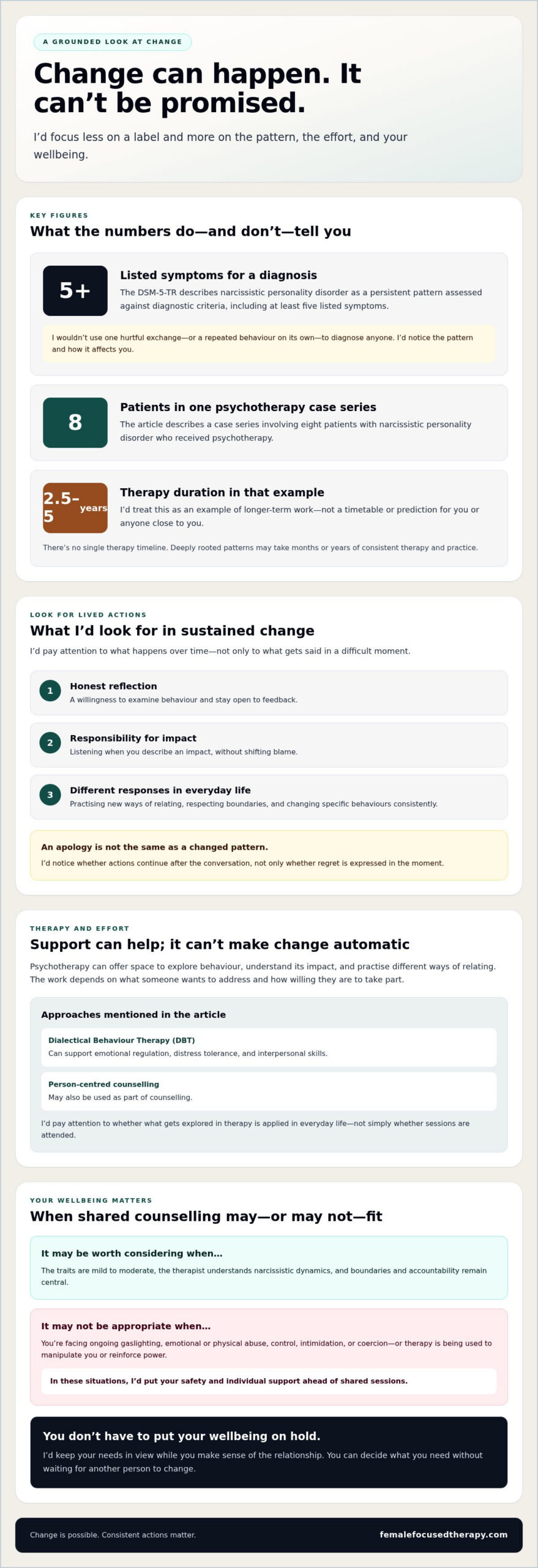
The DSM-5-TR describes narcissistic personality disorder as a diagnosable mental disorder. A diagnosis requires a persistent pattern that includes at least five listed symptoms. The DSM-5 describes defining traits as grandiosity, a constant need for admiration, and a lack of empathy.
If a partner’s behaviour unsettles you, focus on what happens over time and how it affects you, rather than trying to decide whether a label fits. One argument in which your feelings are dismissed may be painful, but it does not establish a personality disorder. Notice whether the behaviour forms a wider pattern and whether your concerns can be heard.
I work with women on relationship experiences and emotional wellbeing. You can read about who I work with if you’re considering support for yourself.
Therapy Approaches and Duration
Psychotherapy can provide space to explore narcissistic tendencies, understand their impact, and practise different ways of relating. The work depends on what someone wants to address and how willing they are to take part. No therapy method makes change automatic.
Dialectical Behaviour Therapy, or DBT, can support emotional regulation, distress tolerance, and interpersonal skills. These areas may be challenging for someone with narcissistic personality disorder. Counselling may also use a person-centred approach. What matters is whether someone applies what they explore in therapy to everyday life, not simply whether they attend.
There’s no single timeline for therapy. I’d expect deeply rooted patterns to take months or years of consistent therapy and practice. The authors of the psychotherapy case series described eight patients with narcissistic personality disorder who received psychotherapy for 2.5 to 5 years. I’d treat that as an example of longer-term work, not a timetable for you or anyone close to you.
So, can a narcissist change with therapy? Therapy may help when someone is willing to examine their behaviour and practise different responses. If you’re weighing up their efforts, notice whether they listen when you describe an impact, respect a boundary, and take responsibility without shifting blame. Those actions tell you more than a label alone.
How narcissistic traits may affect the prospects for change
Look beyond a label and notice how behaviour affects the relationship over time. Pay attention to whether your partner can hear you, show empathy, and take steps to address the impact of their actions.
Common Narcissistic Traits
I use “narcissistic traits” to describe behaviours such as self-importance, a strong need for admiration, difficulty recognising other people’s needs, or reacting badly to criticism. I’d consider the pattern and its impact on you, rather than treating one moment as proof of a diagnosis.
For example, if you raise a concern and your partner repeatedly turns the conversation into a defence, your feelings may go unheard. That experience matters, whether or not a diagnostic label applies. Focus on what happens between you and what you need to feel respected.
Traits and Prospects for Change
Your partner’s response to feedback can help you assess whether change is taking place. Empathy for someone close and a willingness to take corrective action can support growth. Dismissing feedback or blaming you can make shared reflection harder.
Notice what happens after a difficult conversation. Listening, considering the impact, and changing a specific behaviour are different from agreeing in the moment and then repeating it. Look for accountability in everyday choices, not only during a crisis or when the relationship feels at risk.
Couples counselling may be worth considering when the traits are mild to moderate, the therapist understands narcissistic dynamics, and boundaries and accountability remain central. These conditions matter because both people need room to speak honestly and take responsibility for their part.
Couples counselling may not be appropriate if you’re facing ongoing gaslighting, emotional or physical abuse, control, intimidation, or coercion. It is also concerning if therapy is used to manipulate you or reinforce power. In these situations, prioritise your safety and individual support over shared sessions.
If you want to discuss a difficult pattern, name one behaviour and its effect rather than arguing over whether your partner is a narcissist. For example, you might say, “When my concern is mocked, I stop feeling safe enough to talk.” Then state the boundary you need, such as ending the conversation if the mocking continues. This keeps the discussion grounded in an observable event and your own experience.
If this dynamic has left you doubting yourself, I offer support around narcissistic abuse. You can book an appointment to explore what support might help you feel steadier.
What Role Does Self‑Awareness Play?
Willingness to reflect, motivation to change, and honest self-awareness can support change. Blaming you, rejecting feedback, or refusing to discuss a repeated pattern can get in the way.
Willingness, Motivation, and Self-Awareness
Self-awareness means noticing how your behaviour affects others and staying open to what you learn. Recognising a pattern can help someone choose a different response instead of simply defending the old one.
For example, a partner who notices they dismiss your concerns might ask what they missed and listen. Someone who attends therapy only to prove you wrong may not be ready to explore their part. Motivation matters when it leads to reflection and practice outside the therapy room.
Success is more than saying, “I know I can be difficult.” Look for a specific connection between behaviour and impact: “I interrupted you, and that made it harder for you to speak.” This gives the person something concrete to work on, such as pausing before responding.
Accountability and Personal Insight
Accountability means taking responsibility for a behaviour and its effect, without making you responsible for it. Insight becomes meaningful when it shapes what someone does next.
If your partner apologises after a hurtful comment, notice whether they can name the comment, acknowledge its effect, and avoid repeating it. “I’m sorry you felt hurt” shifts attention to your reaction. A direct apology recognises the behaviour itself and makes room for repair.
Therapy can also explore self-esteem and sensitivity to rejection. Someone who experiences feedback as rejection may become defensive when you raise a concern. Understanding that response can help them practise hearing feedback without turning the conversation into an argument about their worth.
Your boundaries don’t depend on your partner’s self-awareness. You might say, “I’ll continue this conversation when we can speak without insults,” and step away if the insults continue. A clear boundary describes what you will do; it is not a way to make someone change.
Notice how the pattern affects your mental wellbeing, too. If you feel tense before seeing friends or keep rehearsing how to avoid upsetting your partner, make time for a supportive conversation with someone you trust. That step can help you reconnect with your own perspective.
Self-awareness may open the door to change, but it does not make you responsible for keeping someone else on track. You can recognise effort while protecting your limits. If an apology is followed by the same behaviour, you’re allowed to take that pattern seriously and decide what you need next.
Recognising signs of sustained behavioural change
Look for patterns in everyday behaviour, not one moving conversation. A useful sign is a continuing willingness to hear feedback and act differently afterwards.
In a relationship, change matters through its effects: whether you can speak honestly, maintain your boundaries, and feel heard. One calm week alone cannot show whether a new pattern is taking hold.
What change can look like in daily life
Notice what happens after a disagreement. If your partner interrupts less, listens to your full concern, and asks what they could do differently, those actions matter more than a promise made during an argument.
Openness to feedback is another sign to notice. Your partner might hear that a comment felt dismissive, pause, and consider your experience rather than insisting you misunderstood. Not every conversation will go smoothly, so look for an ongoing willingness to reflect.
Entitlement can show up in everyday choices, such as expecting you to cancel plans whenever your partner wants attention. A change might look like accepting your separate plans without punishment, sulking, or pressure. Focus on whether your needs are treated as real, not whether your partner uses the right words.
Beliefs can take longer to shift than a single behaviour. If your partner once assumed disagreement meant disrespect, an emerging change might be curiosity about your point of view. Notice whether they consider your perspective repeatedly, including when they feel criticised.
Repair within a relationship
After hurtful behaviour, an honest repair means naming what happened, recognising its impact, and taking a practical step to prevent it happening again. For example, after sharing private information without permission, your partner might acknowledge the breach and respect your request for privacy going forward.
Words matter, but an apology without changed behaviour leaves the same hurt in the relationship. Notice whether repair continues after the immediate tension has passed, rather than appearing only when your partner fears losing something.
You can keep your own record of specific events if it helps you see patterns more clearly. Note what happened, how your partner responded, and whether anything changed afterwards. This is not a test or a diagnosis. It can help you trust your observations when repeated conversations leave you doubting them.
How therapy skills may support change
Dialectical Behaviour Therapy (DBT) can support emotional regulation, distress tolerance, and interpersonal skills. For example, pausing during a heated exchange may help someone respond without escalating the conflict or shutting down.
These skills matter in real moments: hearing “no”, managing disappointment, or returning to a difficult conversation. Look for practice beyond therapy sessions, such as your partner taking a break respectfully and returning to listen. Lasting change is less about never feeling defensive and more about handling that feeling without making you responsible for it.
Psychotherapy for narcissistic tendencies
Psychotherapy can help someone explore narcissistic thought patterns and practise different ways of relating. Focus on their willingness to understand their behaviour rather than assuming a label predicts what therapy can achieve.
A person-centred approach can offer space to speak openly and notice how beliefs affect relationships. Someone might explore why disagreement feels like rejection, then practise hearing a different view without dismissing it. This work can support empathy, which means making room for another person’s experience in everyday conversations.
Therapy may also explore how someone responds to criticism, shame, or disappointment. They might revisit a recent moment when they felt slighted, consider what they assumed, and reflect on how they acted. This can bring hidden beliefs into view, such as “I must always be admired” or “being wrong makes me worthless”. The aim is to understand those reactions and choose a response that causes less harm.
Psychotherapy may help with narcissistic thought patterns when Machiavellianism and psychopathy associated with the Dark Triad aren’t also present. I wouldn’t use that phrase to diagnose someone from the outside. In a real relationship, it’s more useful to notice whether treatment supports honest reflection or whether therapy language is used to manipulate, excuse behaviour, or strengthen control.
Trauma can also be part of the picture. Addressing a clearly identifiable traumatic event may help someone understand thought patterns that developed as coping responses. This does not make harmful behaviour acceptable, nor does it mean every narcissistic tendency comes from trauma. Both things can be true: past pain may deserve care, while present actions still call for accountability.
Therapy is a process, not a shortcut. Engagement might look like someone pausing during conflict, returning to the conversation, and listening without turning it into a test of who is right. Notice whether your boundaries are respected outside sessions, not just discussed in them.
If you’re affected by narcissistic behaviour, your mental health deserves attention, too. You might write down a recent interaction, what happened, and how it left you feeling. This can help you bring a clear example into a supportive conversation without needing to prove a diagnosis or explain away the impact.
If you’d like support making sense of your experience and finding steadier ground, you can book an appointment.
Female Focused Therapy: Individual Psychotherapy Sessions
At Female Focused Therapy, I offer individual psychotherapy for women seeking support with relationship patterns, emotional overwhelm, or recovery after narcissistic abuse. You don’t need to diagnose your partner or decide whether they’ll change before exploring how the relationship affects you.
In therapy, I can help you make sense of what you’re experiencing, reconnect with your needs, and consider boundaries that feel right for you. I also offer online therapy if meeting remotely suits your circumstances. The focus is your wellbeing and steps that support a steadier relationship with yourself.
If you’d like to explore support, you’re welcome to visit Female Focused Therapy.
Choose a next step that centres you
The question of whether a narcissist can change with therapy can take up a lot of mental space. Gently bring the focus back to what you need today. You don’t have to settle the future of a relationship before seeking support or making a thoughtful choice for yourself.
You might begin by writing down what would help you feel safer, clearer, or more like yourself. Perhaps you need space to think, a conversation with someone you trust, or support to understand this relationship’s effect on you. Small steps can help you hear your own needs beneath the uncertainty.
Reaching out can feel like a big step, especially if you’ve spent a long time doubting yourself. You can take it at your own pace. My work is grounded in careful listening and helping you find a way forward that feels true to you.
If you’d like to explore support, you’re welcome to book an appointment. You deserve space to reconnect with your judgement and move forward with care.
Frequently Asked Questions
Does therapy help with narcissism?
Yes, therapy can help someone address narcissistic behaviour when they’re willing to examine its impact. Look for whether the work leads to different choices outside sessions, such as listening to feedback without turning it into blame. If you’re reflecting on your own patterns, bring a recent disagreement to therapy and explore what you felt, how you responded, and what you might try differently next time.
Narcissist Relationship Recovery: What’s Possible for the Relationship?
Recovering within a relationship can involve rebuilding trust, changing how conflict is handled, and agreeing on boundaries that both partners respect. Notice how repair unfolds after a difficult moment, not just whether you both want the relationship to continue. For example, a shared plan might include returning to a conversation after a pause and making room for each person’s concerns without insults or pressure.
Can You Ever Fully Trust Again?
Yes, you can rebuild trust, including trust in your own judgement. Start with small, observable choices: keeping a boundary, asking for time to think, or noticing whether someone follows through on an agreement. If a past relationship left you questioning your perceptions, write down what happened and how you felt. This can help you ground decisions in your experience instead of pressure to forgive quickly.
Can love change a person with NPD?
Love alone does not create lasting behavioural change. Caring for someone and taking responsibility for their growth are not the same thing. If you love someone with NPD, you can express what you need, but you cannot do their reflection or therapy for them. Pay attention to their choices and protect your wellbeing rather than making hope your measure of progress.
Do narcissists know they are narcissists?
Some people with narcissistic personality disorder may not recognise it. A person’s agreement or disagreement with a label does not prove either way. If you’re trying to make sense of a relationship, focus on behaviour you can describe, such as repeated belittling or disregard for your boundaries. A diagnosis cannot be established from a partner’s actions alone.
Do people with NPD change as they get older?
Age alone does not tell you whether someone’s behaviour will change. Look instead for willingness to reflect, openness to feedback, and effort that continues beyond one conversation. Notice whether someone can hear a concern without dismissing it and make a different choice later. You do not need to wait for a particular life stage to decide what boundaries you need now.
Is it possible to live happily with a narcissist?
Your happiness in a relationship depends on more than a label. Consider whether you can express your needs, make independent choices, and disagree without intimidation or coercion. If you often feel you must manage your partner’s reactions to avoid conflict, take that experience seriously. Individual support can help you clarify what feels acceptable, whether or not your partner chooses therapy.
Can narcissistic personality disorder improve with therapy?
Yes, therapy may reduce symptoms and help someone move towards remission, but it doesn’t cure narcissistic personality disorder. I’d distinguish improvement from a promise that every pattern will disappear. For you, useful signs include your concerns being heard and boundaries respected in ordinary situations. If you’re supporting someone in treatment, let their actions over time guide your decisions about closeness and trust.

Article by
Cheryl Kennedy MacDonald MA BA (Hons) Pg. Dip. SAC BACP
Cheryl Kennedy MacDonald is a psychotherapist specialising in women’s mental health, relationships, and life transitions. She works with women navigating trauma, relationship breakdown, identity shifts, and midlife change, helping them rebuild self-trust, emotional stability, and a clear sense of who they are and what they want.
With over 20 years’ experience working with women internationally, Cheryl is the founder of YogaBellies, a global women’s yoga school, and the creator of the Birth ROCKS method. Her work sits at the intersection of psychotherapy and embodiment, integrating evidence-based therapeutic approaches with somatic, body-based practices that support deep, lasting change.
Known for her grounded and direct approach, Cheryl moves beyond surface-level insight to address the patterns held in the body and nervous system. Her work supports women to regulate, reconnect, and respond to their lives from a place of clarity, strength, and self-respect.
She is a published author in academic journals and has written multiple books on women’s health, pregnancy, and midlife wellbeing, available on Amazon and leading book retailers worldwide.